
Earthquakes in the Dominican Republic are a constant reality due to the country’s geographical position, located at the intersection of active tectonic plates. Although the population is accustomed to minor tremors, the seismic threat is real and requires planning, regulations, and responsible construction. Understanding how earthquakes work in the Dominican Republic and how this affects construction is essential for anyone thinking about investing, buying land, or building a house or villa.
This article explains the seismic context of the country, the current regulations, how they are applied in real construction projects, and what a client should demand to ensure that their investment is safe.
The seismic context of the Dominican Republic
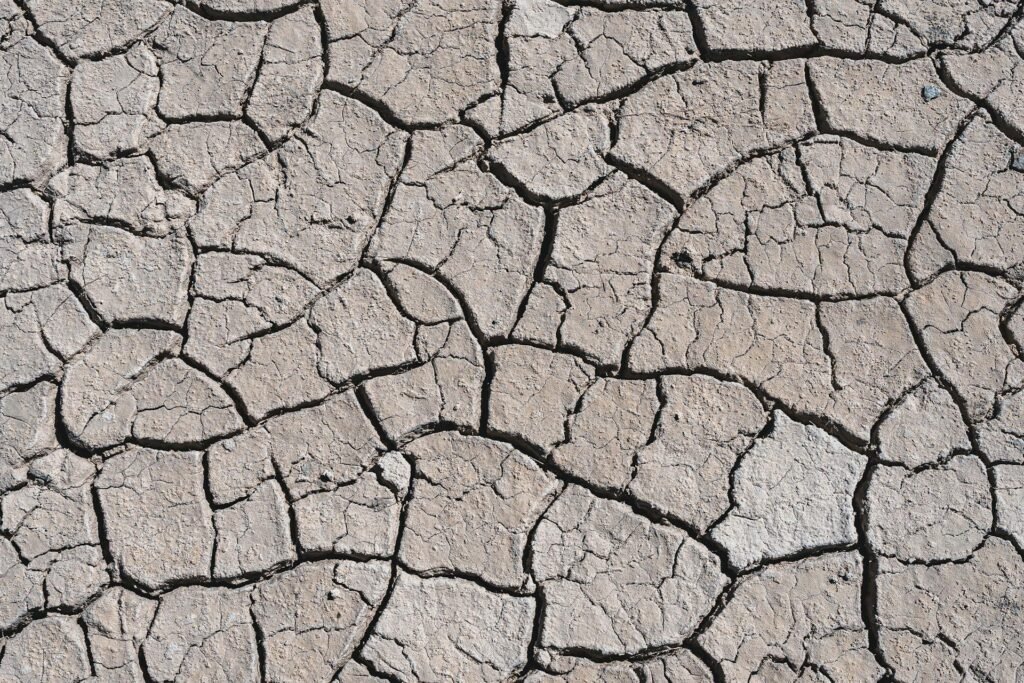
Earthquakes in the Dominican Republic occur due to the interaction of the Caribbean Plate and the North American Plate. Much of the north of the country lies on or near the Septentrional Fault, while the southern region is influenced by the Enriquillo–Plantain Garden Fault, one of the most active in the Caribbean.
Significant historical earthquakes
- Samaná 1946 (M ~8.0): one of the strongest earthquakes in the modern Caribbean, which generated a tsunami.
- Puerto Plata 2003 (M 6.5): significant structural damage and a reminder of the vulnerability of the north.
- Other moderate events are recorded each year, especially in the northern and eastern regions.
These facts demonstrate that earthquakes in the Dominican Republic are not isolated events, but rather part of the natural behavior of the territory.
Anti-seismic standards and regulation R-001
To respond to the seismic threat, the Dominican Republic has Regulation R-001 for Seismic Analysis and Design of Structures, approved by Decree 201-11. This document establishes the minimum requirements for designing homes, buildings, schools, hotels, and any structure that must withstand seismic activity.
Key principles of the regulation
- All structures must be able to withstand moderate earthquakes without serious damage.
- In strong earthquakes, the priority is to protect life by preventing total collapse.
- Establishes seismic zones based on expected acceleration.
- Classify buildings by importance (residential, commercial, hospitals, etc.).
- It requires specific structural details to ensure ductility and strength.
Regardless of the size of the project, all formal construction must comply with these regulations. Therefore, knowing the rules is essential for any investment or project in areas prone to earthquakes in the Dominican Republic.
Importance of soil studies
Earthquakes affect different types of terrain in different ways. For this reason, the country has supplementary regulations such as R-024, which regulates the geotechnical studies necessary to determine soil capacity, the water table, and the appropriate type of foundation.
Por qué es indispensable un estudio de suelo
- Avoid building on unstable areas or uncompacted fill.
- Determine whether piles, strip footings, or special slabs are needed.
- Reduces the risk of settling or tilting.
- Ensures that the structure responds adequately during earthquakes in the Dominican Republic.
Investing without conducting a soil study is one of the most common mistakes in coastal and hilly areas.
How the rules are applied in a real house or project
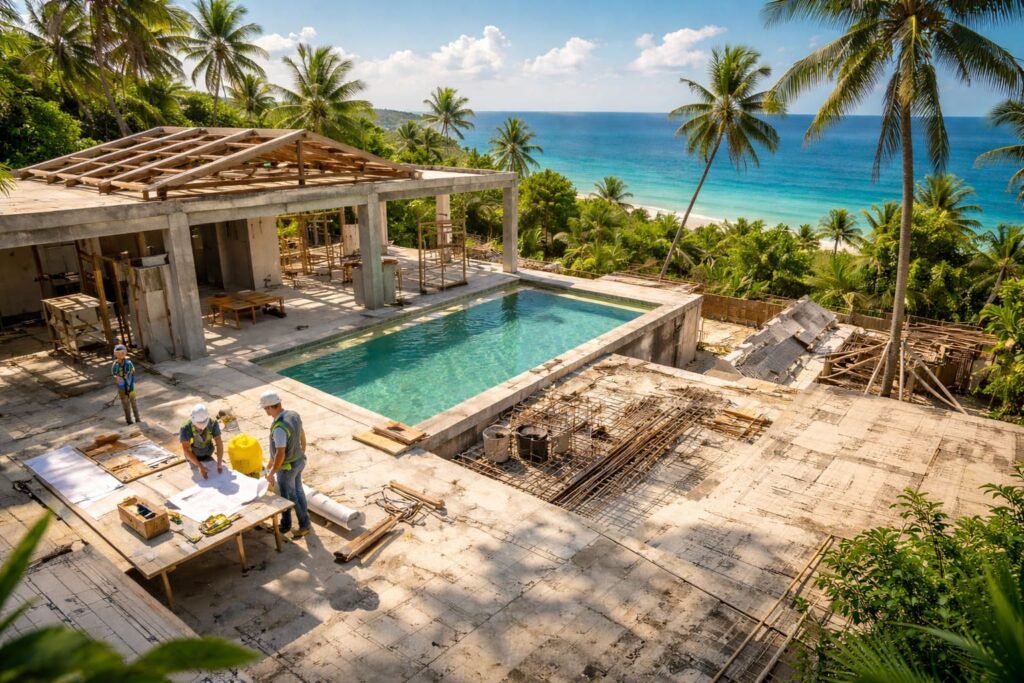
For a building to be earthquake-safe in the Dominican Republic, the structural design must be carried out by a specialized engineer, who determines:
- Size and quantity of structural steel.
- Dimensions of columns and beams.
- Type of foundation according to soil type.
- Location of structural walls.
- Details for absorbing seismic energy.
This is NOT improvised, copied, or done “by eye.”
Each project is different and requires specific calculations.
Common mistakes in construction that increase seismic risk
Much of the damage caused by earthquakes in the Dominican Republic is not due to the force of the event, but rather to poor construction practices:
Common mistakes
- Second-level extensions without reinforcing columns.
- Ground floors converted into parking lots without walls, losing rigidity.
- Columns without stirrups or with insufficient steel.
- Construction without professional supervision.
- Poorly compacted fill on hillsides or near rivers.
Informality is the greatest enemy of seismic safety.
Checklist for buyers and investors
Before investing in a property or starting construction, check the following:
- Does the project mention compliance with R-001?
- Is the structural design signed off by a licensed engineer?
- Was a soil study conducted on the land?
- Is the work supervised by professionals?
- Does the builder provide technical documents and structural reports?
- Are there municipal and ministerial permits?
This checklist protects your investment and reduces the risk of earthquakes in the Dominican Republic.
Conclusion: investing and building responsibly
Earthquakes in the Dominican Republic are part of the country’s natural environment, but thanks to seismic codes and good engineering practices, it is possible to build highly safe homes, villas, and buildings.
Seismic safety is not a luxury, it is an obligation. Anyone who invests, builds, or buys should demand professional standards.
Build safely with All Project Group SRL
At All Project Group SRL, we design and build in accordance with current seismic regulations, applying soil studies, professional supervision, and international standards.
We offer:
- Construction of villas and projects in Las Terrenas.
- Architecture adapted to seismic zones.
- Building permits.
- Project development and technical supervision.
More information: https://allprojectgroup.com/construction-company-in-las-terrenas/