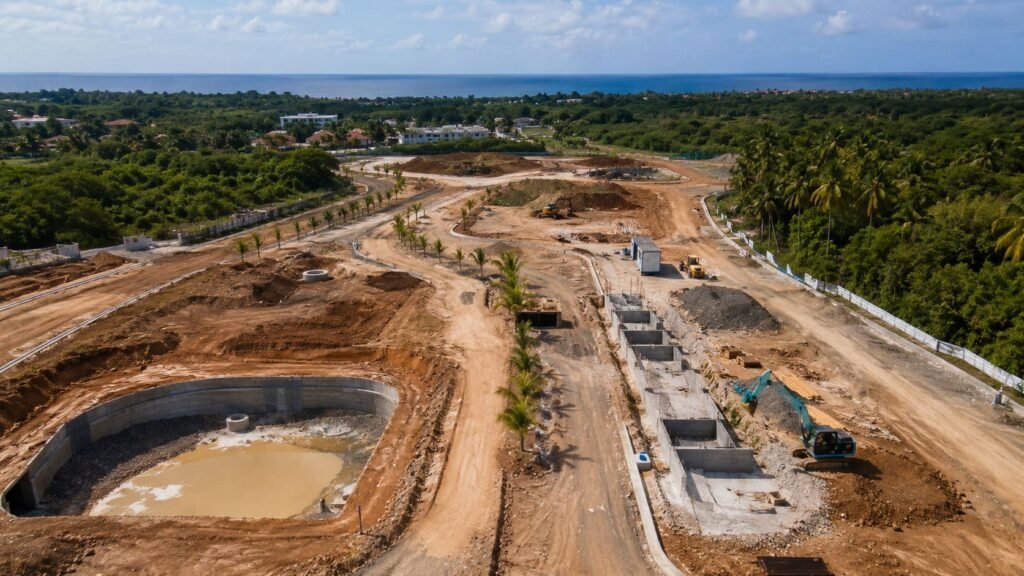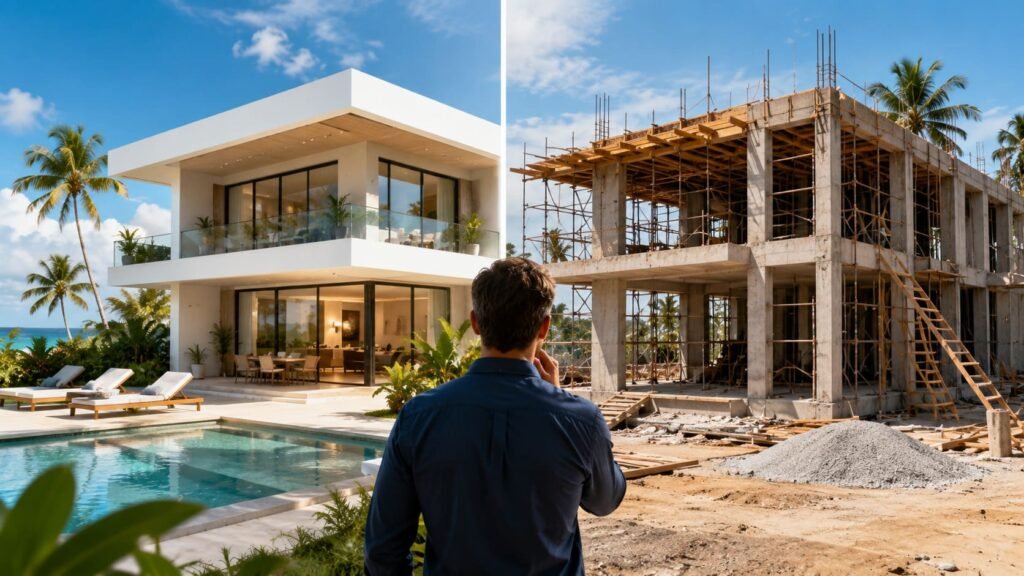

Construction in flood-prone areas is one of the greatest technical challenges in tropical zones such as the Dominican Republic and, in particular, in areas such as Las Terrenas. Many terrains that at first glance seem ideal hide problems related to water accumulation, high water table or saturated soils, which can seriously compromise a construction project if adequate measures are not taken from the beginning.
This article explains in a clear way what construction in flood-prone areas involves, what the real risks are and what technical solutions exist to build safely and durably.

What is considered a floodplain or uneven terrain?
A floodplain is a land with recurrent accumulation of water, either due to heavy rainfall, poor natural drainage or a high water table. In many cases, these lands correspond to old swamps, wetlands or low areas where water tends to stagnate.
In Las Terrenas it is common to find land that combines topographic irregularities with flooding problems, which further complicates construction. Construction in flood-prone areas must analyze both the behavior of the soil and the natural movement of water.
Why these plots are common in Las Terrenas
Climatic and geographic conditions explain the presence of this type of terrain:
- Intense and concentrated tropical rains
- Low areas near the sea
- Clayey soils with poor drainage capacity
- Urban expansion on natural land
- Old fillings without technical criteria
These characteristics make construction in floodplains a critical issue for those who wish to invest or build in the area.
Risks of poorly planned construction
When construction on flood-prone land is carried out without adequate studies and solutions, problems usually appear in the short or medium term:
- Frequent flooding in patios and first floors
- Constant humidity in foundations and walls
- Differential soil settlements
- Structural cracks
- Accelerated deterioration of materials
- High maintenance costs
- Loss of real estate value
These risks are not always evident at the start of the work, but become apparent over time.
Indispensable studies prior to construction
Construction in flood-prone areas requires prior technical studies to make informed decisions:
- Geotechnical study: determines soil bearing capacity and water table.
- Drainage analysis: identifies how water behaves in heavy rains.
- Historical evaluation of the terrain: allows for the detection of recurrent flooding.
- Topographic review: key to define slopes and runoff.
Without these studies, any constructive solution is a risky bet.
Technical solutions for floodplain construction
Although complex, floodplain construction is possible when appropriate solutions are applied:
Terrain elevation
Technical backfill compacted in layers to raise the construction elevation above the flood level.
Elevated platforms
Design of houses on platforms that allow the passage of water without affecting the structure.
Drainage systems
Perimeter and subway drains that channel water away from the building.
Special foundations
Use of elevated footings, reinforced slabs or piles depending on the type of soil.
Suitable materials
Choice of materials resistant to humidity and occasional contact with water.
These solutions must be designed by professionals and adapted to each specific terrain.
Construction on uneven and sloping land
Many floodplains also have slopes or gradients. In these cases, construction in floodplains must also consider:
- Well-dimensioned retaining walls
- Surface runoff control
- Integration of architectural design with topography
- Protection against soil erosion
Proper planning can turn a complex site into a successful project.
Common mistakes to avoid
Some common mistakes in floodplain construction include:
- Backfilling without technical compaction
- Blocking natural drains in the land
- Build to original ground level
- Ignoring the behavior of water in extreme rainfalls
- Copying solutions from other fields without prior analysis
Avoiding these mistakes saves time, money and future problems.
Is it worth investing in a floodplain?
Investing in a floodplain may be viable when:
- The price compensates for the necessary technical solutions
- The location is strategic
- The project is well planned
However, this is not always advisable. Floodplain construction should be evaluated considering the total cost of the project, not just the value of the land.
The importance of working with professionals
Floodplain construction requires local expertise, technical knowledge and a holistic view of the project. Working with a professional construction company allows:
- Correctly evaluate the terrain
- Designing appropriate solutions
- Comply with local regulations
- Reduce technical and economic risks
At All Project Group SRL we accompany our clients from the initial analysis of the land to the design and construction, offering solutions adapted to the specific conditions of each lot and the tropical environment.
👉 If you are evaluating land or planning to build, you can contact us here.
Conclusion
Building in floodplains is a common challenge in tropical areas such as Las Terrenas, but it is not an impediment when approached with planning and technical judgment. Understanding the behavior of soil and water is the basis for building safely, functionally and durably.
Before building, properly evaluating the site can make the difference between a successful project and a long-term problem.